

Truck driver hours of service rules are federal limits on how long many commercial drivers can drive, work, and remain on duty before taking required breaks or rest periods. In plain language, these rules are meant to reduce fatigue and lower the risk of serious crashes. They matter not only to trucking companies and drivers, but also to anyone sharing the road with large commercial vehicles.
This article provides general information about how these rules work and why they often come up after a collision. In truck crash investigations, logbooks, electronic logging device data, dispatch records, and related documents may be reviewed to better understand driving time, rest periods, and on-duty activity. Because regulations can change and every incident involves its own facts, the details are often evaluated through a careful records review rather than assumptions.
Why these rules matter
Hours of service rules are closely tied to roadway safety because fatigue can affect attention, reaction time, and judgment. They also matter in a legal-information context because compliance records may help investigators piece together a timeline after a crash. The goal here is to explain the topic clearly, not to offer case-specific advice or predict any outcome.
What FMCSA Hours of Service Rules Cover
FMCSA hours of service rules are federal limits that govern how long many commercial motor vehicle drivers can drive, how much total on-duty time they can accumulate, and when they must take rest breaks or off-duty periods. In simple terms, these rules are designed to reduce fatigue and create a basic framework for safer truck and bus operations.
At a high level, the rules most people search for include the 11 hour driving limit, the 14-hour on-duty window, the 30-minute break requirement, and the 60/70-hour weekly limits. These are best understood as connected limits rather than separate rules. A driver may still run out of available time under one rule even if another limit has not yet been reached.
The core daily and weekly limits
In plain English, the daily rules generally control how long a driver can spend behind the wheel and how long the overall workday can last before more rest is required. The weekly caps then limit how many on-duty hours can build up over several days. Sleeper berth rules may also affect how qualifying rest is counted, but the exact details can become technical quickly.
Who these rules generally apply to
These rules commonly apply to many interstate commercial drivers, but exact coverage depends on the type of vehicle, cargo, route, and operation. Exceptions, short-haul provisions, and carrier-specific facts can change how the rules apply in a real case. If you are reviewing a crash or compliance issue, it may also help to understand how auto injury lawyers help after a crash.
Because regulations can change and facts matter, this section is only a general overview rather than a complete legal interpretation of every hours-of-service situation.
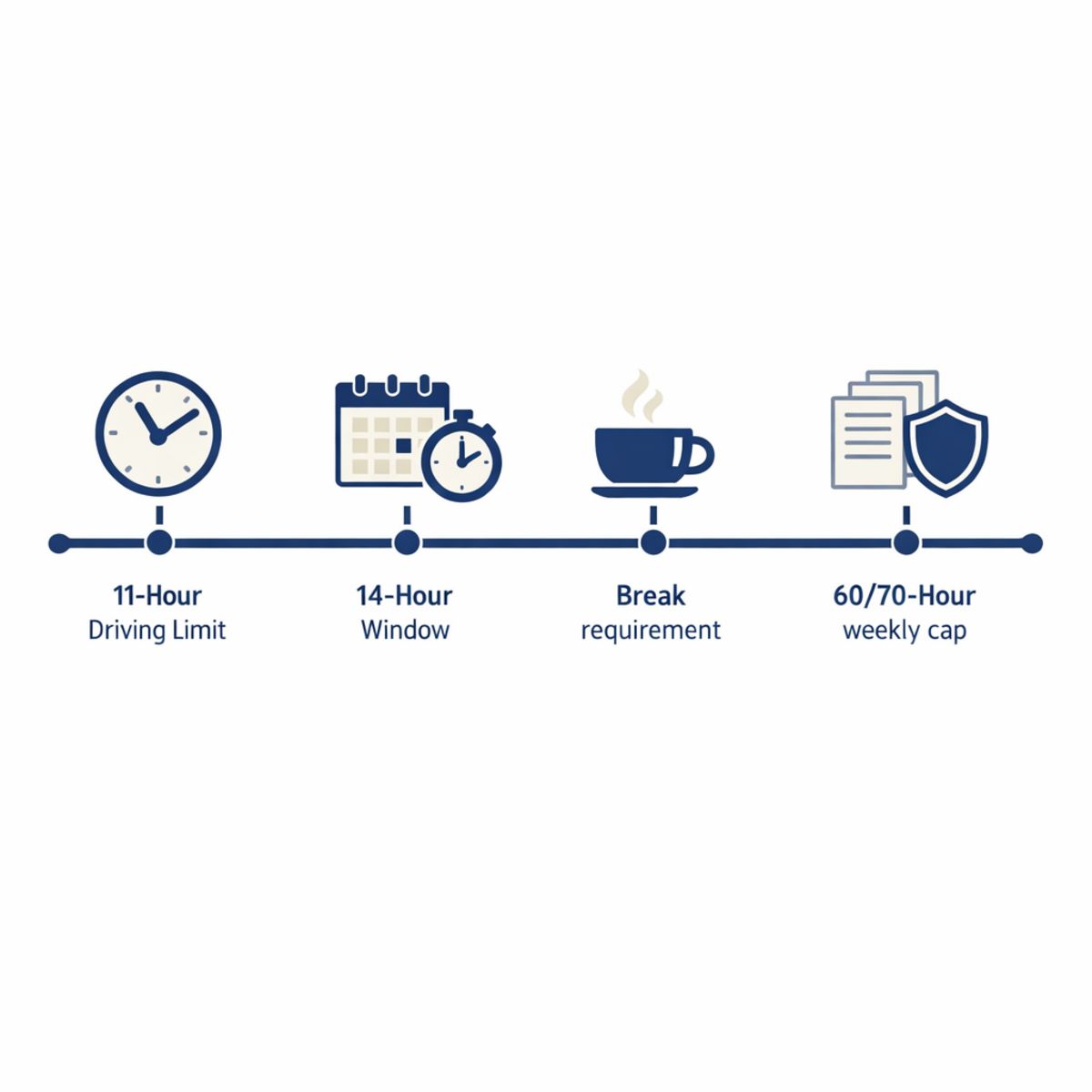
The Key Limits Drivers and Carriers Must Track
Hours-of-service rules are built around a few core limits that shape how commercial trips are scheduled in practice. For anyone trying to understand truck driving hour rules, the main idea is simple: there are daily driving caps, a daily on-duty window, required breaks, and weekly totals that can restrict how much work can be done over several days. These limits can become especially important when dispatch timing, loading delays, traffic, and route demands all affect the day at once. If you need broader truck accident lawyer legal guidance page information, it helps to understand how these time limits generally work.
11-hour driving limit
The 11 hour driving limit means a driver may drive only up to 11 hours after getting the required off-duty time before starting a new shift. In practical terms, this is a cap on actual driving time, not the entire workday. A driver might spend part of the day inspecting the truck, fueling, waiting at a shipper, or handling paperwork, but only the time spent driving counts toward that 11-hour total.
14-hour on-duty window
The 14-hour on-duty window is different because it limits how long the driver may remain in the driving window after coming on duty. Once that window starts, the clock generally keeps moving even if the driver is not actively driving. For example, time spent during inspections, fueling, traffic stops, loading, or unloading can reduce the remaining time available to drive later in the day. That is why a delay early in a shift can affect the rest of the route.
Breaks and weekly hour caps
Drivers also have to account for break rules and cumulative weekly limits. In general terms, a 30-minute break requirement can apply after a certain amount of driving-related time, and the 60/70-hour rule limits how many on-duty hours may be accumulated over a period of days. These weekly caps are meant to reduce fatigue over time, not just within a single shift. In real operations, that means a schedule may look workable on one day but still run into limits when several long days add up across the week.

Why Hours of Service Rules Matter for Road Safety
Hours of Service rules exist to address a practical safety concern: fatigue can affect reaction time, attention, and decision-making behind the wheel. In commercial transportation, long shifts and irregular schedules can increase the risk of reduced alertness, which is why these rules are intended to create minimum rest opportunities and limit excessively demanding driving patterns.
Fatigue and driving performance
When discussing truck driver fatigue, it is important to use balanced language. Fatigue may contribute to slower responses, missed hazards, or lapses in concentration, but it is only one factor in roadway safety. Hours of Service compliance is designed to support safer operations by setting baseline expectations for rest and driving time, not by guaranteeing that every trip is risk-free.
Compliance records are also just one part of the broader safety picture. Maintenance practices, driver training, traffic conditions, weather, and road design can all play a role in how a crash occurs or is prevented. For readers looking at the legal side of accident cases, this article on the personal injury lawyer role in vehicle claims may provide additional context.
How Hours of Service Records May Be Reviewed After a Truck Crash
In a truck crash investigation, one part of the review may involve looking at hours-of-service records alongside other time-stamped documents. The goal is not to assume a result from the start, but to understand the sequence of events and whether the available records appear consistent with each other.
Records that may be compared
Common materials can include data from an electronic logging device, dispatch communications, fuel receipts, toll records, bills of lading, delivery paperwork, inspection records, and other supporting documents. Each source may show part of the timeline. For example, a log entry showing driving time may be compared with a fuel purchase timestamp or a shipping document showing pickup or delivery activity. Investigators may also review entries reflecting driving, on-duty not driving, off-duty, and sleeper berth periods to see how those entries align with outside records.
Why preliminary information is not the full picture
Early reports after a crash are often limited. They may capture basic observations, but they do not always include the full set of records that can later be reviewed. As additional documents are gathered, the timeline may become clearer, especially where there are questions about travel times, stops, rest periods, or work activity before the collision.
Whether any hours-of-service violation occurred is a fact-specific question. A records review may reveal consistency, inconsistency, or the need for more context, which is why comparisons are typically made across multiple sources rather than from a single document alone.

Paper Logs, Electronic Logging Devices, and Supporting Records

Traditional paper logs and an electronic logging device can each provide useful information, but they do not always answer every question on their own. Paper logs may show how a driver reported duty status, while electronic logging devices can create time-stamped records tied to vehicle movement and status changes. In practice, reviewing either source often requires context rather than assumptions.
That practical need for context is similar to broader evidence review in transportation and injury matters, including understanding what a car accident attorney does when comparing multiple records instead of relying on one document alone. A log may appear complete, yet questions can still arise about route timing, breaks, duty status changes, or whether an operational exception applied.
Why supporting documents still matter
Supporting records such as fuel receipts, dispatch entries, toll data, shipping paperwork, and delivery confirmations may be reviewed alongside ELD data or paper logs. These materials can help confirm timing, locations, and sequence of events. The key point is not that one record source automatically proves liability, but that multiple sources together may help create a more accurate picture of what happened.
Common Misunderstandings About Hours of Service Rules
Myth: A driver can keep driving all day if total mileage is low. Fact: Hours of Service rules focus on time limits and duty status, not just miles traveled.
Myth: Being stopped or waiting always counts as off duty. Fact: Time off the road is not automatically off-duty time; the specific status matters.
Myth: One log entry settles every compliance issue. Fact: A single record rarely answers the full question without context, timing, and related entries.
Bottom line: These issues are often fact-specific. If a crash raises concerns about driver scheduling or log compliance, truck accident lawyer support after collisions may help evaluate the bigger picture.
Frequently Asked Questions About Truck Driver Hours of Service Rules
What is the 11-hour driving limit for truck drivers?
In general, many covered truck drivers may drive for up to 11 hours after taking the required off-duty period. That limit does not stand alone, though, because other hours of service rules can also restrict when and how long a driver may continue working or driving.
What is the 14-hour rule in hours of service regulations?
The 14-hour rule generally sets the outer window in which a covered driver may drive after coming on duty. In plain terms, the clock keeps moving once the workday starts, and non-driving tasks can still count against that window even if the truck is not moving.
Are truck drivers required to use electronic logging devices?
Many commercial trucking operations are required to use electronic logging devices, often called ELDs, to record hours of service information. However, not every driver or operation is covered in the same way, and some exceptions may apply depending on the type of work involved.
Why do hours of service records matter after a truck crash?
Hours of service records can help investigators review a driver’s timeline, duty status, and rest periods around the time of a crash. These records may show whether additional review is needed, but they do not automatically determine fault or guarantee any particular outcome.
When Legal Guidance May Help
Truck accident matters may involve records review, regulatory questions, and multiple sources of documentation. For readers looking for more vehicle accident legal information and support, it may be helpful to understand how these issues can apply when a commercial truck is involved.
If you would like to discuss a collision involving a commercial truck, you can contact the firm to learn more about the process and general next steps. Reaching out is simply a way to request information about your situation.
Key Takeaways on Truck Driver Hours of Service Rules
Truck driver hours of service rules set limits on driving time, on-duty windows, required breaks, and cumulative weekly hours. Their central purpose is to reduce fatigue and support safer operation of commercial vehicles on the road.
In practice, these rules matter not only for day-to-day compliance but also after a collision. In a truck accident hours of service review, electronic logging device data and related supporting records may be examined as part of a broader investigation into driver activity and timing.
Final summary
Taken together, HOS rules provide a framework for managing work and rest, with fatigue prevention at the center. Understanding the basic limits and the role of records helps explain why these regulations are often relevant in crash-related reviews.