
As reported by California Highway Patrol incident log
Date: November 24, 2026, 4:04 a.m.
Location: I-215 southbound near Central Avenue, Riverside, Riverside
Type: Pedestrian Accident
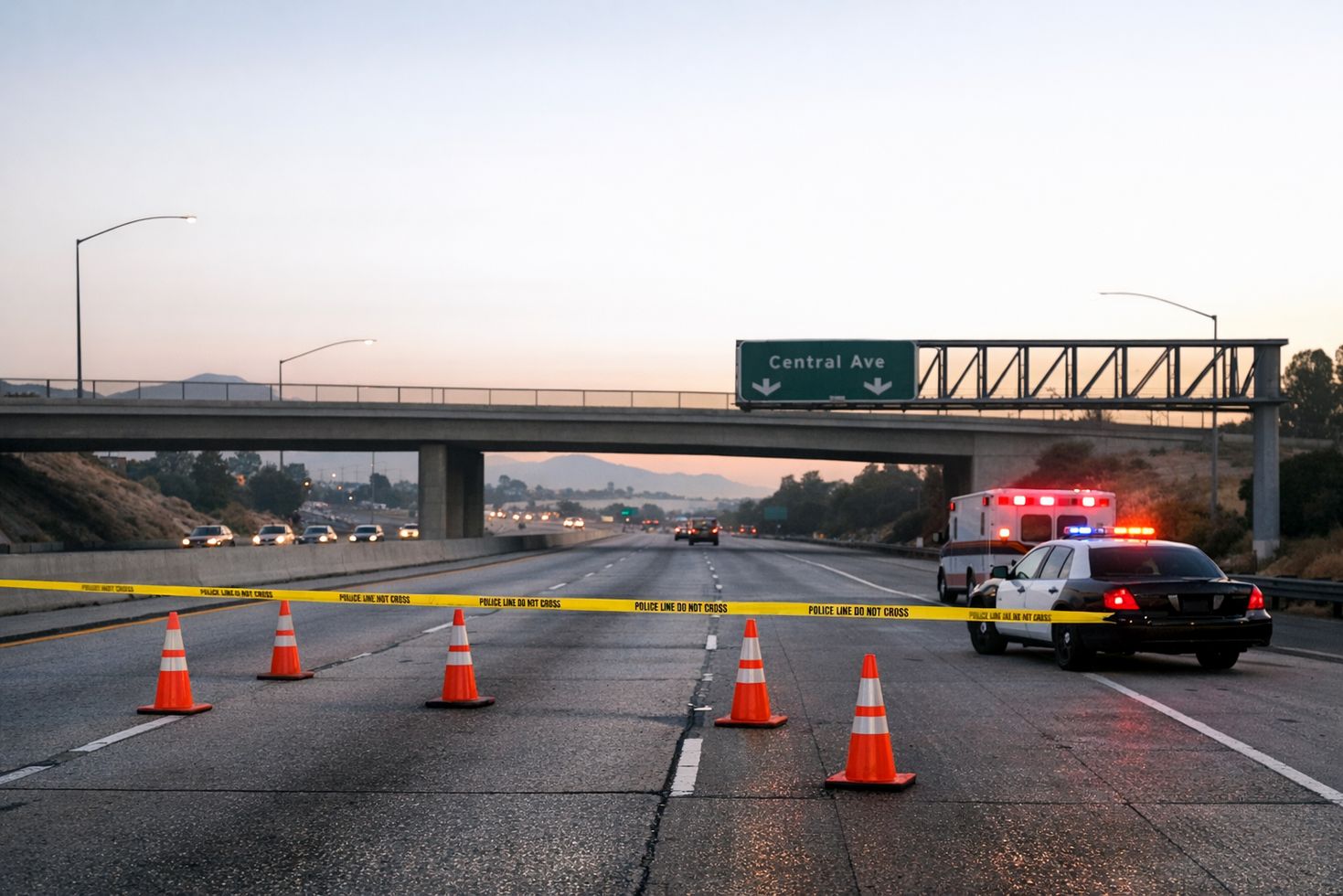
According to California Highway Patrol incident logs, dispatchers received reports of a traffic collision involving a vehicle and a pedestrian on southbound Interstate 215 near Central Avenue at about 4:04 a.m. Tuesday.
Log entries stated that a vehicle struck a pedestrian who was walking on the freeway, described as a vehicle versus pedestrian collision. According to the log, a sedan was reported in the center divider and high-occupancy vehicle lane, with notes that the pedestrian might have been on top of the vehicle’s hood. The final incident type was recorded as a traffic collision with an ambulance requested, indicating medical response was called but not confirming injuries.
The log indicated that all southbound lanes were stopped just north of Central Avenue while responders worked in the center divider. According to the dispatch notes, Riverside Fire Department and CAL FIRE were notified and units were responding, with fire crews reported stuck in traffic en route. The log also referenced contact with Riverside Community Hospital and Riverside Police Department during the response.
Source
California Highway Patrol incident log · original report
This summary was prepared from that report and is not a reproduction of it.
What California law says after a pedestrian accident
Right of way rules for people walking and cycling
California drivers must yield to a pedestrian crossing in a crosswalk, and a crosswalk exists at most intersections whether or not it is painted. Drivers approaching a pedestrian in a crosswalk must also slow down or take other care for that person’s safety. Pedestrians in turn must not leave a curb so suddenly that a driver cannot yield.
Since the 2023 change commonly called the Freedom to Walk Act, an officer generally may not stop a pedestrian for crossing outside a crosswalk unless there is an immediate danger of a collision. That change limits enforcement; it does not remove the pedestrian’s duty to use care, and in a civil case that duty still counts when fault is divided.
A related rule addresses visibility. Parking is prohibited within twenty feet of the approach side of any crosswalk, marked or unmarked, and within fifteen feet where a curb extension is present. A vehicle parked in that zone can hide a person stepping into the roadway from an approaching driver, and since January 2025 the restriction is enforceable whether or not the curb is painted.
For bicycles, the Three Feet for Safety Act requires a driver passing a cyclist travelling in the same direction to leave at least three feet of clearance, and where another lane in the same direction is available and it is practicable and lawful, to change lanes before passing. Where three feet is not possible, the driver must slow to a reasonable and prudent speed and pass only when it would not endanger the cyclist.
Being outside a crosswalk, or not wearing a helmet, does not by itself establish that a pedestrian or cyclist was legally at fault. Under California’s comparative fault rule, those facts are weighed alongside everything else that happened.
California filing deadlines for injury and death claims
In California, a lawsuit for personal injury caused by another person’s negligence generally must be filed within two years of the injury, under Code of Civil Procedure section 335.1. A claim for a death caused by another’s wrongful act or neglect runs under the same two-year period.
Shorter deadlines apply in specific situations. If a city, county or state agency may be responsible, a written claim must normally be presented to that public entity within six months. Claims involving minors, injuries that are not discovered right away, and certain defendants can follow different timelines.
Which deadline applies depends on the facts of each situation, and the standard two-year period does not govern every claim.
Your Rights After a Pedestrian Accident in California
A collision like this one raises questions about fault, insurance and medical costs, usually before anyone has had time to think about them. These guides explain how California handles them.
- Pedestrian and vehicle accident claims: how fault is determined when a person on foot is struck
- Brain and spinal cord injury lawyer: for collisions causing serious or lasting injury
- All practice areas
If you were hurt in a collision, The Law Offices of Burg and Brock, Inc. can explain your options.
Published by The Law Offices of Burg and Brock editorial team. The incident summary was drafted with AI assistance from the cited report. Editorial and legal disclaimer.
This website is for informational purposes only and does not provide legal advice. Using this site does not form an attorney/client relationship. This site is legal advertising.
This article is general information, not legal advice.