
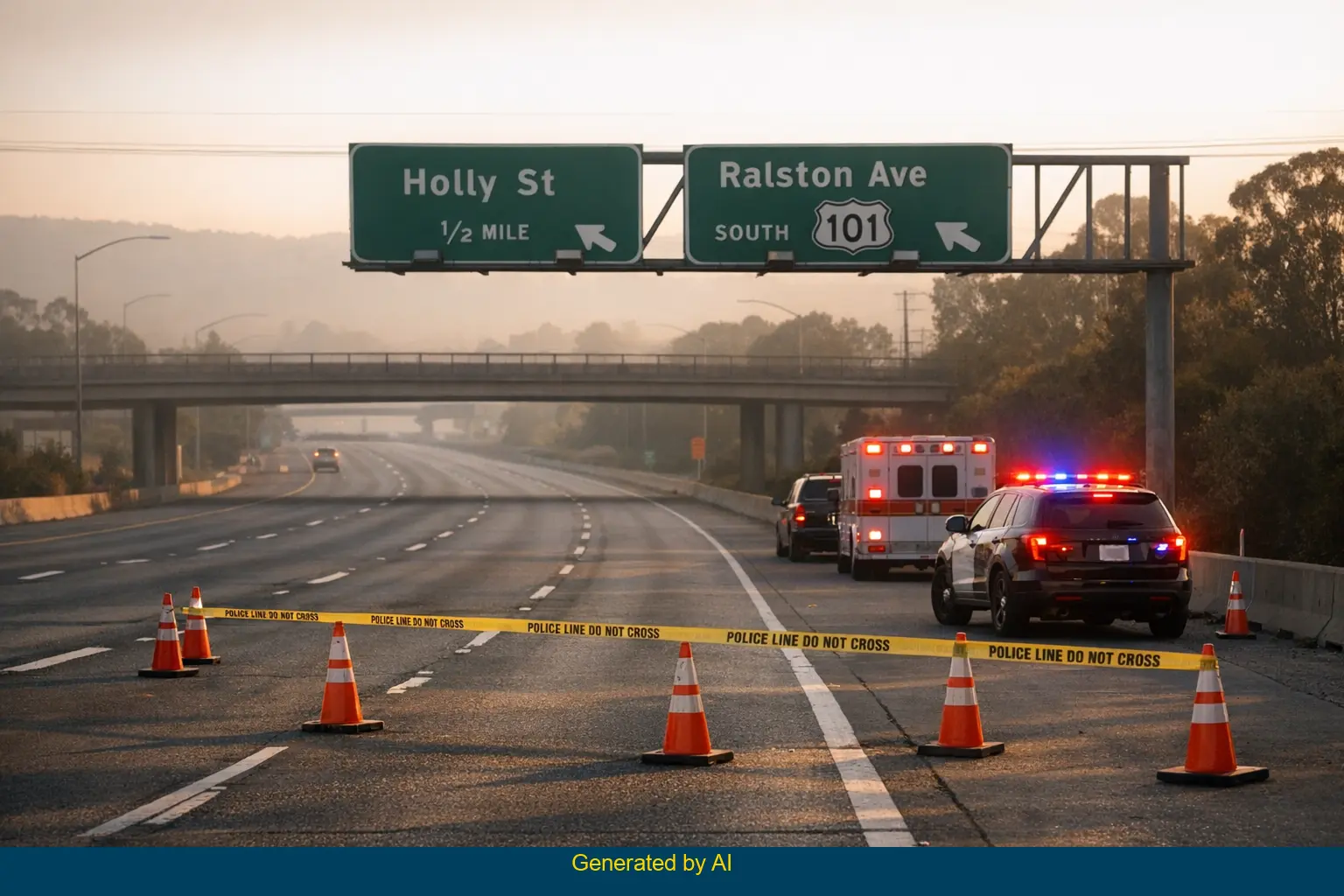
Early on August 30, a pedestrian was fatally struck on southbound US 101 near the Holly Street off-ramp, prompting lane closures and a Sigalert.
Pedestrian Accident
Authorities responded early August 30, 2026, to reports of a pedestrian walking in lane 2 of US 101 southbound near the Holly Street and Ralston Avenue area. Radio traffic indicated the pedestrian was moving back and forth in the lanes and was in the middle of traffic. Officials initially reported no associated vehicle. At about 2:54 a.m., officials reported a vehicle-versus-pedestrian collision on southbound US 101 with major injuries and requested a hard closure of the roadway. A Sigalert was issued, and all southbound lanes were shut down just north of Ralston while officers conducted traffic breaks. Emergency medical crews and fire personnel accessed the scene, including traveling the wrong way up an off-ramp due to the closure. A gray Kia Telluride was identified as an involved vehicle, and the person in that vehicle was reported uninjured. The pedestrian was pronounced dead at 3:05 a.m. by fire personnel. The coroner was notified. A white Dodge Challenger with moderate front-end damage was later towed from the scene. Lane 1 reopened around 3:55 a.m., and all lanes were reported open by about 5:15 a.m., though flares remained in the roadway for a time. The collision remains under investigation by authorities.
Incident Details
What California law says after a pedestrian accident
Who may bring a wrongful death claim in California
When a collision results in death, California law allows specific family members to bring a wrongful death claim. The categories are defined by statute and generally include a surviving spouse or domestic partner, children, and, where there is no surviving spouse or issue, others who would be entitled to the property of the person who died. Certain dependents, including a putative spouse, stepchildren, or parents who were financially dependent, may also qualify.
A wrongful death claim compensates surviving family members for their own losses, including financial support, funeral and burial expenses, and the loss of the companionship, guidance, and society the person provided.
A separate claim, called a survival action, covers losses the person themselves sustained before death, such as medical expenses and lost earnings. California law changed here. For survival actions filed on or after January 1, 2026, damages for the decedent’s own pain, suffering, or disfigurement are no longer recoverable. Cases filed before that date are not affected, and different rules can apply in elder abuse matters.
Eligibility depends on family circumstances, filing deadlines are strict, and the damages available depend in part on when a case is filed.
Right of way rules for people walking and cycling
California drivers must yield to a pedestrian crossing in a crosswalk, and a crosswalk exists at most intersections whether or not it is painted. Drivers approaching a pedestrian in a crosswalk must also slow down or take other care for that person’s safety. Pedestrians in turn must not leave a curb so suddenly that a driver cannot yield.
Since the 2023 change commonly called the Freedom to Walk Act, an officer generally may not stop a pedestrian for crossing outside a crosswalk unless there is an immediate danger of a collision. That change limits enforcement; it does not remove the pedestrian’s duty to use care, and in a civil case that duty still counts when fault is divided.
A related rule addresses visibility. Parking is prohibited within twenty feet of the approach side of any crosswalk, marked or unmarked, and within fifteen feet where a curb extension is present. A vehicle parked in that zone can hide a person stepping into the roadway from an approaching driver, and since January 2025 the restriction is enforceable whether or not the curb is painted.
For bicycles, the Three Feet for Safety Act requires a driver passing a cyclist travelling in the same direction to leave at least three feet of clearance, and where another lane in the same direction is available and it is practicable and lawful, to change lanes before passing. Where three feet is not possible, the driver must slow to a reasonable and prudent speed and pass only when it would not endanger the cyclist.
Being outside a crosswalk, or not wearing a helmet, does not by itself establish that a pedestrian or cyclist was legally at fault. Under California’s comparative fault rule, those facts are weighed alongside everything else that happened.
Information for Families After a Fatal Collision
Losing a family member in a collision raises urgent legal questions, often long before anyone feels ready to ask them. These guides set out the basics, with no obligation attached.
- California wrongful death attorney: who may file, the deadlines that apply, and what a claim covers
- Pedestrian and vehicle accident claims: how fault is determined when a person on foot is struck
- All practice areas
Injured in This Accident? Get Trusted Legal Guidance
After an accident, the right information can make a meaningful difference. If you or a loved one was hurt, The Law Offices of Burg and Brock, Inc. can help you understand your rights and options.
Speak with our legal team today before making important decisions.