
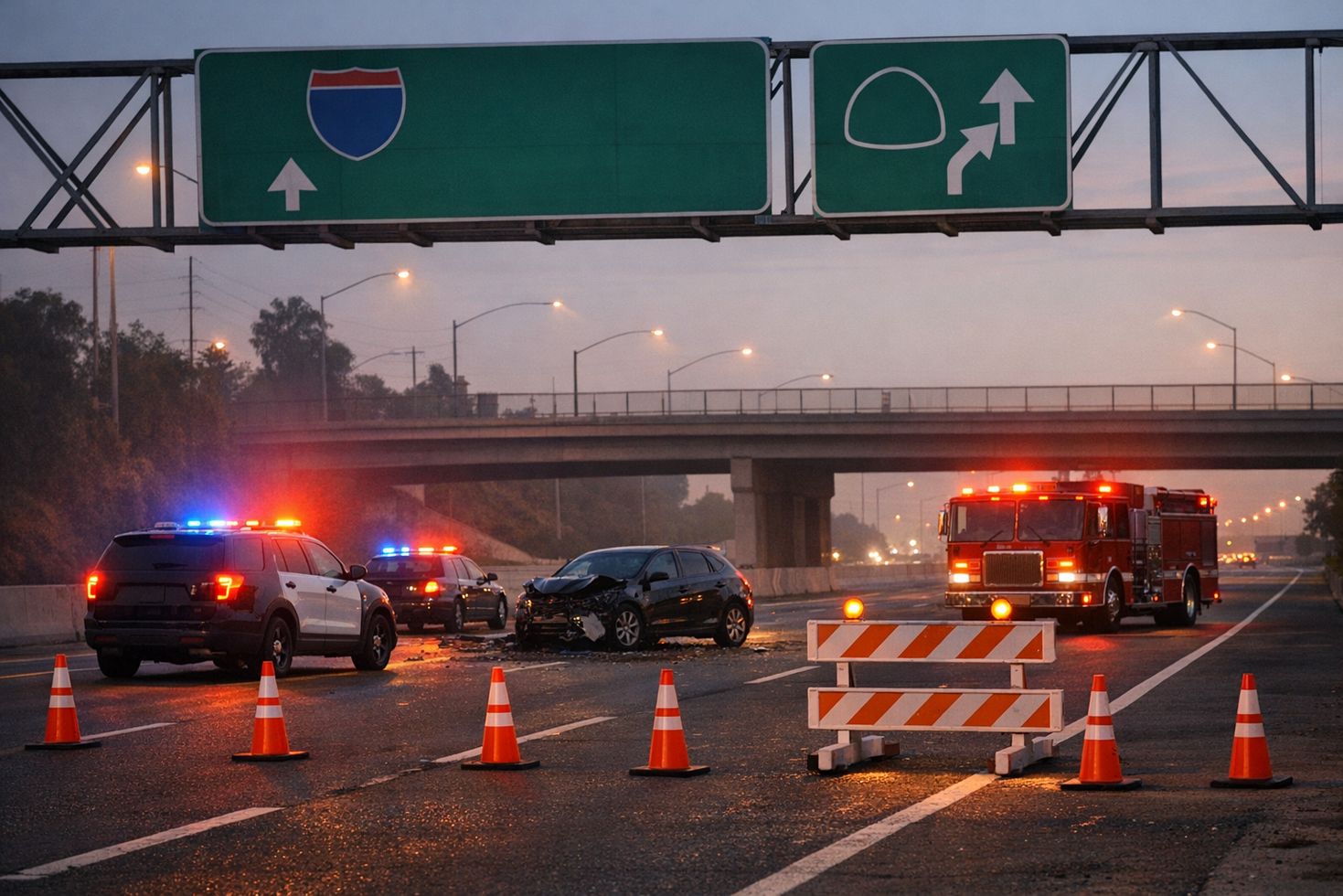
As reported by CHP Fatal Accident Feed
Date: October 6, 2026, 12:29 a.m.
Location: Northbound Interstate 605 near State Route 91, just south of South Street, Los Angeles County
Type: Car Accident
California Highway Patrol dispatch logs show a fatal crash early Tuesday on northbound Interstate 605 near the State Route 91 interchange in Los Angeles County.
Shortly after 12:30 a.m., callers reported a black sedan damaged and facing the wrong way in the middle lanes near the transition ramps. Debris was scattered across the roadway, and the vehicle was described in the log as wrecked and burned, though no active flames were seen. There was initially no sign of anyone in or around the car.
According to the logs, a smell of smoke prompted a precautionary request for the Los Angeles County Fire Department. An iPhone crash notification was also received from the area with an open line and no response.
Around 12:40 a.m., additional entries indicated that a second vehicle, described as an SUV, had collided with the sedan, turning the incident into a two-vehicle crash. One of the vehicles was reported on a right-shoulder embankment, and a tow truck operator arrived behind the crash scene with lights activated.
Multiple tow companies were called to the scene as responders worked to secure the area. At about 1:01 a.m., CHP reclassified the incident from a crash with unknown injuries to a fatal collision. The coroner was notified a short time later, and several tow trucks were requested to remove vehicles as evidence.
Logs show that all lanes were stopped near South Street, and CHP asked Caltrans to implement a full closure of northbound I-605 just south of SR-91. The Transportation Management Center and the sheriff’s department assisted with traffic control and with closing South Street on-ramps to the freeway.
A SigAlert was issued while investigators documented the scene and crews worked around the vehicles. Some lanes were gradually reopened, but other lanes remained closed for several hours.
By about 2:55 a.m., the coroner was recorded on scene, and fire crews were requested with cutting tools to help remove a body from a vehicle. Tow operators later transported multiple vehicles to a tow yard to be held as evidence.
According to the CHP log, the SigAlert was canceled and the incident was closed between about 4:40 and 4:45 a.m. The freeway closure was fully lifted shortly after, and by around 5:20 a.m. officers reported the vehicles were secured at a tow yard for follow-up investigation.
Details on the person who died, including identity and role in the crash, were not provided in the dispatch summaries. The cause of the collision remains under investigation, according to the CHP logs.
Source
CHP Fatal Accident Feed · original report
This summary was prepared from that report and is not a reproduction of it.
What California law says after a car accident
Who may bring a wrongful death claim in California
When a collision results in death, California law allows specific family members to bring a wrongful death claim. The categories are defined by statute and generally include a surviving spouse or domestic partner, children, and, where there is no surviving spouse or issue, others who would be entitled to the property of the person who died. Certain dependents, including a putative spouse, stepchildren, or parents who were financially dependent, may also qualify.
A wrongful death claim compensates surviving family members for their own losses, including financial support, funeral and burial expenses, and the loss of the companionship, guidance, and society the person provided.
A separate claim, called a survival action, covers losses the person themselves sustained before death, such as medical expenses and lost earnings. California law changed here. For survival actions filed on or after January 1, 2026, damages for the decedent’s own pain, suffering, or disfigurement are no longer recoverable. Cases filed before that date are not affected, and different rules can apply in elder abuse matters.
Eligibility depends on family circumstances, filing deadlines are strict, and the damages available depend in part on when a case is filed.
Reporting requirements after a California collision
California imposes reporting duties on drivers that are separate from any insurance claim.
A report must be filed with the DMV on form SR-1 within ten days of a collision that caused any injury, any death, or more than one thousand dollars in property damage to any one person. This duty applies regardless of fault, applies even when police responded and wrote their own report, and is not satisfied by notifying an insurance company. With current repair costs, most collisions that involve a body shop meet the damage threshold.
A separate rule covers collisions causing injury or death. The driver must make a written report to the California Highway Patrol, or to the city police department where the collision happened in a city, within twenty four hours. The statute states this duty for every injury or fatal collision. In practice, where officers responded and completed a report at the scene, that report generally satisfies the agency’s need, but a driver who assumes this without confirming it is relying on practice rather than on the text of the law.
Missing the DMV deadline can lead to suspension of driving privileges, an outcome unrelated to who caused the collision.
Information for Families After a Fatal Collision
Losing a family member in a collision raises urgent legal questions, often long before anyone feels ready to ask them. These guides set out the basics, with no obligation attached.
- California wrongful death attorney: who may file, the deadlines that apply, and what a claim covers
- Los Angeles car accident lawyer: fault, insurance offers, and what a claim is worth
- All practice areas
If a collision has affected your family, The Law Offices of Burg and Brock, Inc. can explain your options.
Published by The Law Offices of Burg and Brock editorial team. The incident summary was drafted with AI assistance from the cited report. Editorial and legal disclaimer.
This website is for informational purposes only and does not provide legal advice. Using this site does not form an attorney/client relationship. This site is legal advertising.
This article is general information, not legal advice.